- Fraud & Scams
How To Spot Phony Email Offers
March 2026
Spotting a Fake Survey Offer

 Financial Articles

How To Spot Phony Email Offers
Have you ever been enticed by an offer from an email? Maybe you’ve been told you won a free prize and just need to take a quick survey to claim it. Or maybe you just need to enter your payment details for shipping. You’ll likely need to act fast because the offer is only for a limited time. The email appears to be coming from a trusted retailer or a place you’ve done business with before.
Among the most common email scams today is the free prize/survey offer. Many retail companies legitimately offer their customers a chance to win a prize for taking a survey, but these scam emails will guarantee a prize, such as a gift card or a new cooler. These offers almost always require the customer to enter payment details to “pay for shipping”. To seem trustworthy, scammers often take logos and images from legitimate companies to pose as them. It’s important to know how to spot fake email offers from real ones.
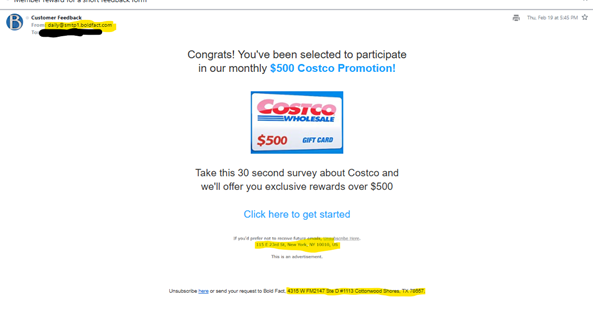
The first red flag is the sender’s email address. It doesn’t contain the word Costco in it. It’s worth noting that the presence of the store’s name in the email doesn’t solely make it legitimate. Scammers will often create fake email addresses designed to look like they’re coming from another source. While it’s easy to create the first half of a fake email address, the domain to which the email belongs is what you really want to look out for. A legitimate email from Costco would likely be from @costco.com.
Another red flag is that this email practically guarantees that the recipient will receive a reward. There are a lot of regulations and laws around surveys offering prizes, and companies offering surveys are required to publish the rules. Generally, they can’t require you to make a purchase to enter or pay a fee for a chance to win.
A big giveaway on email scams is the address listed for the company. If you’re considering clicking on an offer like this, it’s a good idea to search for the address and see if it is associated with the company that’s presenting the offer. If it does not match where the offer is coming from, this is a red flag.
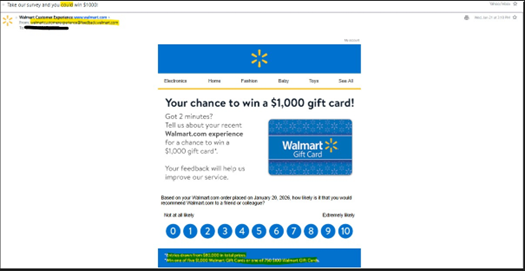
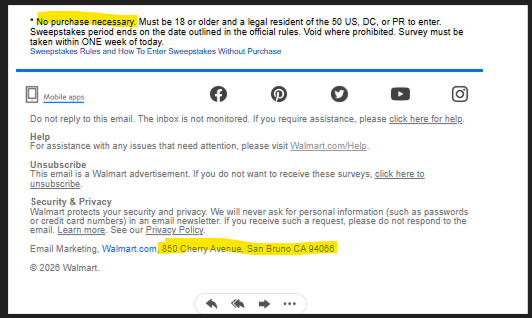
This offer comes from the domain @feedback.walmart.com, matching the company name. The verbiage here is clear you have the chance to win, not a guarantee. This offer also doesn’t appear to be random, referring to an order placed by the recipient that prompted the survey. Lastly, it also clearly defines the conditions for entry, noting that no purchase is necessary to enter.
Remember that email scams are some of the most common scams today. Take a moment to slow down, review emails closely, and always err on the side of caution to protect your information.


We'd love to hear about your experience! Select your office to leave a Google review.
You are now leaving the WESTconsin Credit Union website and going to a website not operated by WESTconsin. WESTconsin is not responsible for the content of this site and the privacy and security policies may differ from those practiced by WESTconsin. The third party website may provide less security than WESTconsin's website. WESTconsin does not represent the third party or you if you enter into a transaction. WESTconsin is not endorsing or guaranteeing the products, information or recommendations provided by linked sites. WESTconsin is not liable for any failure or services advertised on third party sites.